
When you start a business without outside investors, you are the captain of your own ship. Startup bootstrapped financial modeling is simply the act of creating a map for that journey. It is a way to look into the future of your company using only the money you have or the money you expect to make from sales. Many people think financial modeling is only for companies that want to raise millions, but that is a misconception. For a founder using their own savings, a financial model acts as a vital safety net that tells you exactly when you might run out of money.
The primary goal of this type of modeling is long-term survival and independence. While venture-backed companies often focus on rapid growth even if it means losing money, a bootstrapped founder must prioritize profit and cash flow. You are building for longevity. You want to ensure that your business can pay its own bills. By creating a realistic projection, you gain the confidence to make big decisions. It turns the complex world of business finance into a clear path forward that keeps you in control.
The 3 Core Components of a Successful Bootstrapped Financial Model
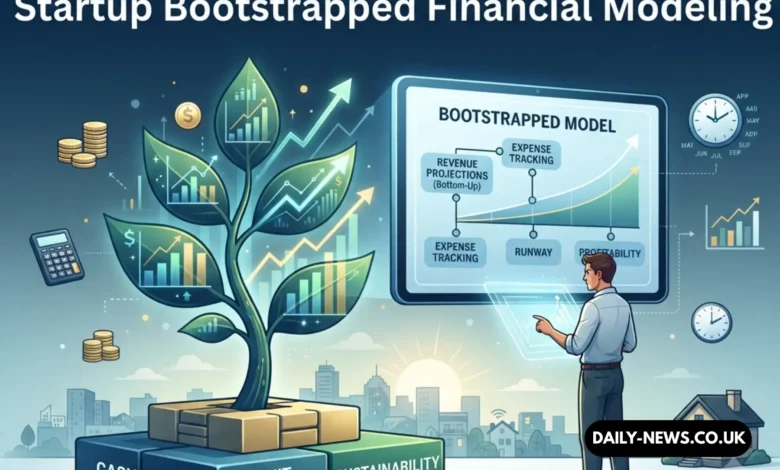
To build a reliable model, you need to focus on three specific areas. First is your revenue projection. Instead of guessing how big the entire market is, look at your actual sales process. How many people visit your site, and what percentage actually buys? This “bottom-up” approach is much more accurate. Second, you must track every single expense. This includes obvious costs like rent, but also the hidden ones like software subscriptions and your own salary. You need to know exactly how much it costs to keep the lights on.
Third, you must manage your cash flow timing. This is the most critical part of startup bootstrapped financial modeling. Even if you make a profit on paper, you can still go out of business if you run out of cash. This happens when customers pay late, but you have to pay your bills immediately. You must plan for these gaps in your timeline so that you always have enough cash in the bank to cover your obligations.
Bootstrapped vs. Venture-Backed: The Difference
The difference between these two paths is control. When you take venture capital, you often give up a piece of your company and agree to grow as fast as possible. Your financial model then becomes a tool to prove to investors that you can hit massive targets. In contrast, bootstrapped financial planning is focused on autonomy. You keep 100% ownership and decide exactly how fast you want to grow.
Bootstrapped startups usually reach the break-even point much faster because they cannot afford to waste money. They have to be lean and smart. While they might not grow at the same speed as a company with millions in funding, they are often much more resilient. They are not beholden to investors who might demand a sale or a shutdown if things get tough.
Step-by-Step Framework for Founders
Building your model does not have to be scary. Start by defining your business model and where your revenue comes from. Next, calculate your unit economics, which is simply the cost to acquire one customer versus how much that customer pays you over time. If you spend more to get a customer than they bring in, you have a problem.
Then, forecast your costs and operational runway. How many months can you survive if you make zero sales? This is your “runway.” Finally, build a 12 to 24-month cash flow forecast. Update this document every single month with your actual results. This will help you see if your assumptions were right or if you need to pivot your strategy.
Stress-Testing Your Model
Even the best plans fail if you are too optimistic. You must stress-test your startup bootstrapped financial modeling by planning for the worst. What if your sales take twice as long to arrive? What if your marketing costs double? By running these “downside scenarios,” you prepare yourself for the unexpected.
It is also vital to compare your model against your real bank statements. If your model says you should have a certain amount of profit but your bank account is empty, you need to find the leak. Treating your model as a living document that changes with reality is the only way to stay safe.
Common Mistakes to Avoid
One common mistake is making your spreadsheet too complex. If you cannot understand your own model, it is useless. Keep it simple so that you can change variables quickly. Another mistake is forgetting one-time costs. Founders often forget about legal fees, website setup, or unexpected equipment repairs. These small costs can add up and derail your entire plan. Also, do not set growth curves that are impossible to hit. Start slow and build momentum based on real data, not on your hopes and dreams.
Essential Tools for Success
You do not need fancy, expensive software to build a great financial model. For most founders, Google Sheets or Microsoft Excel are the best tools. They are flexible and allow you to build connections between your revenue and your expenses. There are many free templates available online that you can download to get started. The important part is not the tool you use, but the discipline you have to update it consistently.
| Tool Type | Benefit for Bootstrappers |
|---|---|
| Google Sheets | Highly flexible, free, and great for collaboration |
| Excel | Robust formulas and powerful data analysis |
| Custom Templates | Saves time and ensures logical connections |
Conclusion
Startup bootstrapped financial modeling is your roadmap to freedom. By focusing on cash flow, unit economics, and conservative growth, you can build a business that stands on its own feet. It is not just about math; it is about taking control of your future. Keep your model simple, review it often, and always plan for the worst while hoping for the best.
FAQs
How often should I update my financial model?
You should review and update your model at least once a month when you reconcile your books.
Is it better to overestimate or underestimate revenue?
Always underestimate revenue and overestimate expenses to provide a safe buffer for your business.
Do I need an accountant to build my model?
You can start on your own, but it is wise to have an accountant review your logic once you have your first draft.
Read More: PedroVazPaulo Business Consultant